Watch
Step through the slides. The trainer's words are under each one.
Know your shotgun
Shotgun, lesson 2 of 8: its parts and how it works
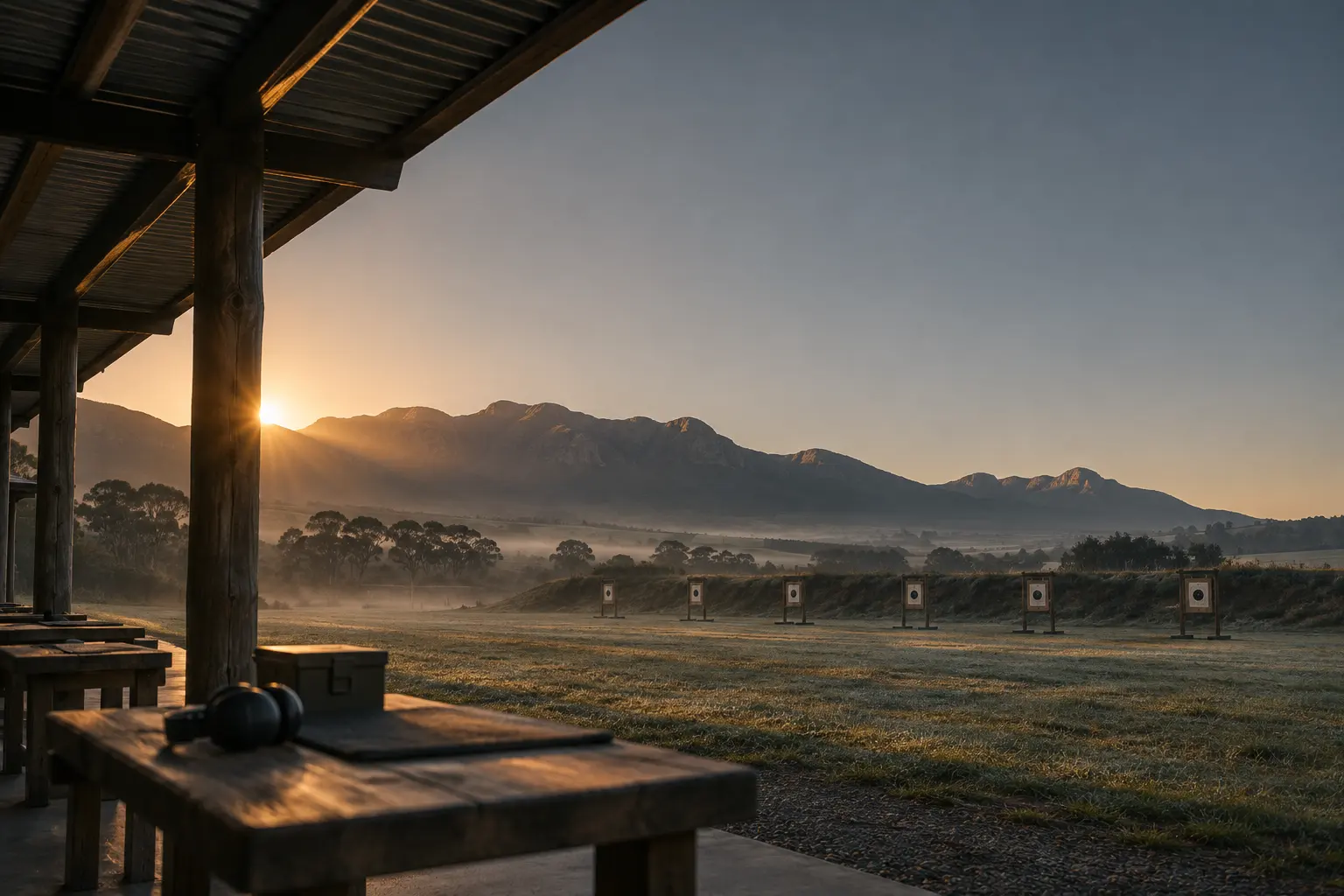
This is lesson 2: know your shotgun. Its parts and how it works. We carry on with Johan and his instructor, Anel, at Ridgeview.
Three common kinds of shotgun
| Kind | How it opens and loads | Seen with it open |
|---|---|---|
| Break-action | Hinges open at the breech; load each barrel by hand | Barrels dropped, chambers visible |
| Pump-action | Slide the forend back and forward to eject and load | Action open, chamber and lifter visible |
| Self-loading | Each shot uses gas or recoil to eject and reload | Bolt locked back, chamber visible |
You will meet three common kinds. A break-action hinges open at the breech, like a book. You load each barrel by hand, and when it is open anyone can see it is safe. Side-by-sides and over-and-unders are both break-actions. A pump-action has a magazine tube under the barrel. You slide the forend back to throw out the empty shell and forward to load the next one. A self-loading shotgun does that cycling itself, using gas or recoil, so it is ready to fire again straight away. Johan shoots an over-and-under, the most common gun on a clay range.
The main parts
| Part | What it does |
|---|---|
| Stock | Sits in your shoulder and against your cheek |
| Action or receiver | Holds the working parts that load, fire and eject |
| Barrel | Guides the shot; marked with the gauge and chamber length |
| Chamber | The rear of the barrel where the cartridge sits |
| Choke | A narrowing at the muzzle that controls how widely the shot spreads |
| Rib and bead | The rib runs along the barrel; the bead at the end is the front sight |
| Trigger and guard | Fires the gun; the guard protects the trigger |
| Safety | Blocks firing, but is a mechanical device that can fail |
| Forend | Where your front hand goes; on a pump it works the action |
These are the parts the unit standard expects you to know. The stock sits in the pocket of your shoulder and against your cheek. The action, or receiver, holds the parts that load, fire and eject. The barrel guides the shot, and is stamped with the gauge and chamber length. The chamber is the rear of the barrel where the cartridge sits. The choke is a slight narrowing at the muzzle: the tighter it is, the tighter the pattern of shot. The rib runs along the top of the barrel to the bead, the front sight. The trigger fires it and the guard protects the trigger. The safety blocks firing, but it is mechanical and can fail, so it never replaces the rules. And the forend is where your front hand goes; on a pump, it also works the action.
What happens when it fires
- 1Trigger pressedReleases the firing pin or hammer
- 2Primer struckA small charge ignites
- 3Powder burnsGas pressure builds in the chamber
- 4Shot and wad leavePushed down the barrel and out of the choke
- 5Shot spreadsInto a pattern that widens with distance
When you press the trigger, it releases the firing pin. The pin strikes the primer in the base of the cartridge, which ignites the powder. The burning powder makes gas, and the gas pushes the wad and the shot down the barrel and out through the choke. Then the shot spreads into a pattern that gets wider the further it goes. If any step fails, you get a malfunction, which is lesson 7.
Inside a shotgun cartridge
A shotgun cartridge is a hull, usually plastic with a brass-coloured base, marked with its gauge and length. In the base is the primer. Above it is the powder. Then the wad, a cup that carries the shot down the barrel, and the shot itself: many small pellets, or a single heavy slug.
Gauge and chamber length are stamped on the barrel
- Gauge is the bore size: a 12-gauge bore is bigger than a 20-gauge
- Chamber length is in millimetres, for example 70 mm or 76 mm
- The cartridge must match both
- Never fire a cartridge longer than the chamber
Look at the side of the barrel and you will find two markings that matter. The gauge is the size of the bore: the smaller the number, the bigger the bore, so a 12-gauge is bigger than a 20-gauge. The chamber length is in millimetres, commonly 70 or 76. Every cartridge you load must match the gauge, and must not be longer than the chamber. A cartridge that is too long can raise the pressure dangerously. Johan's over-and-under is a 12-gauge with 70 mm chambers, and his club cartridges match.
Why 20-gauge and 12-gauge never mix
- 1A 20 slips inIt is small enough to pass the 12-gauge chamber
- 2It lodgesIt sticks in the barrel ahead of the chamber
- 3Click, no bangThe gun seems not to fire, so a 12 is loaded behind it
- 4Barrel burstsFiring the 12 into the blocked barrel
This is one of the most dangerous mistakes with a shotgun, and it is easy to make. A 20-gauge cartridge is small enough to slide past the chamber of a 12-gauge and lodge further down the barrel. Pull the trigger and nothing happens. The shooter thinks it was a dud, loads a 12-gauge behind it and fires, and the barrel can burst in their hands. The rule is simple: never carry two gauges in the same pocket, bag or box. Many makers colour 20-gauge cartridges yellow to help, but you still check.
Which licence covers which shotgun
| Shotgun | Licence |
|---|---|
| Break-action or pump, for self-defence | Section 13 |
| Break-action or pump, for occasional hunting or sport | Section 15 |
| Self-loading, for self-defence (strong reasons needed) | Section 14 |
| Self-loading, for hunting or sport (five shots or fewer) | Section 16, with dedicated status |
A quick link to the Firearms Act course. A shotgun that isn't self-loading can be licensed for self-defence under section 13, or for occasional hunting and sport under section 15. A self-loading shotgun is a restricted firearm for self-defence under section 14. For hunting and sport a self-loading shotgun needs dedicated status and a section 16 licence, and may hold no more than five shots.
Your turn
Before lesson 3
- Do the exercise: Name the part
- Answer four quick questions on this lesson
- Find these parts in your shotgun's manual
Before you move on, do the exercise, Name the part, and answer four quick questions on this lesson. Then, in your own time: find the gauge and chamber length on your shotgun's barrel or in its manual. Next: loading and unloading safely, every time.
Do: Name the part
Anel points at parts of Johan's over-and-under and a club pump-action. Name each part.
Check
Four quick questions. The reason shows as soon as you answer.
Apply
Where this shows up in your own life.
Find the gauge and chamber length on your shotgun's barrel or in its manual
Ridgeview Firearms Academy and its people are fictional. This is study material written from the Firearms Control Act and the SAQA unit standards. It isn't an accredited course or legal advice; your accredited training provider runs the official tests.