Watch
Step through the slides. The trainer's words are under each one.
Safety first
Shotgun, lesson 1 of 8: the rules that prevent accidents
Welcome to the shotgun course, written to unit standard 119652, handle and use a shotgun. Over eight short lessons you follow Johan Pretorius through his training at Ridgeview. This first lesson is the rules that keep everyone safe.
Forty years of clays, one new habit
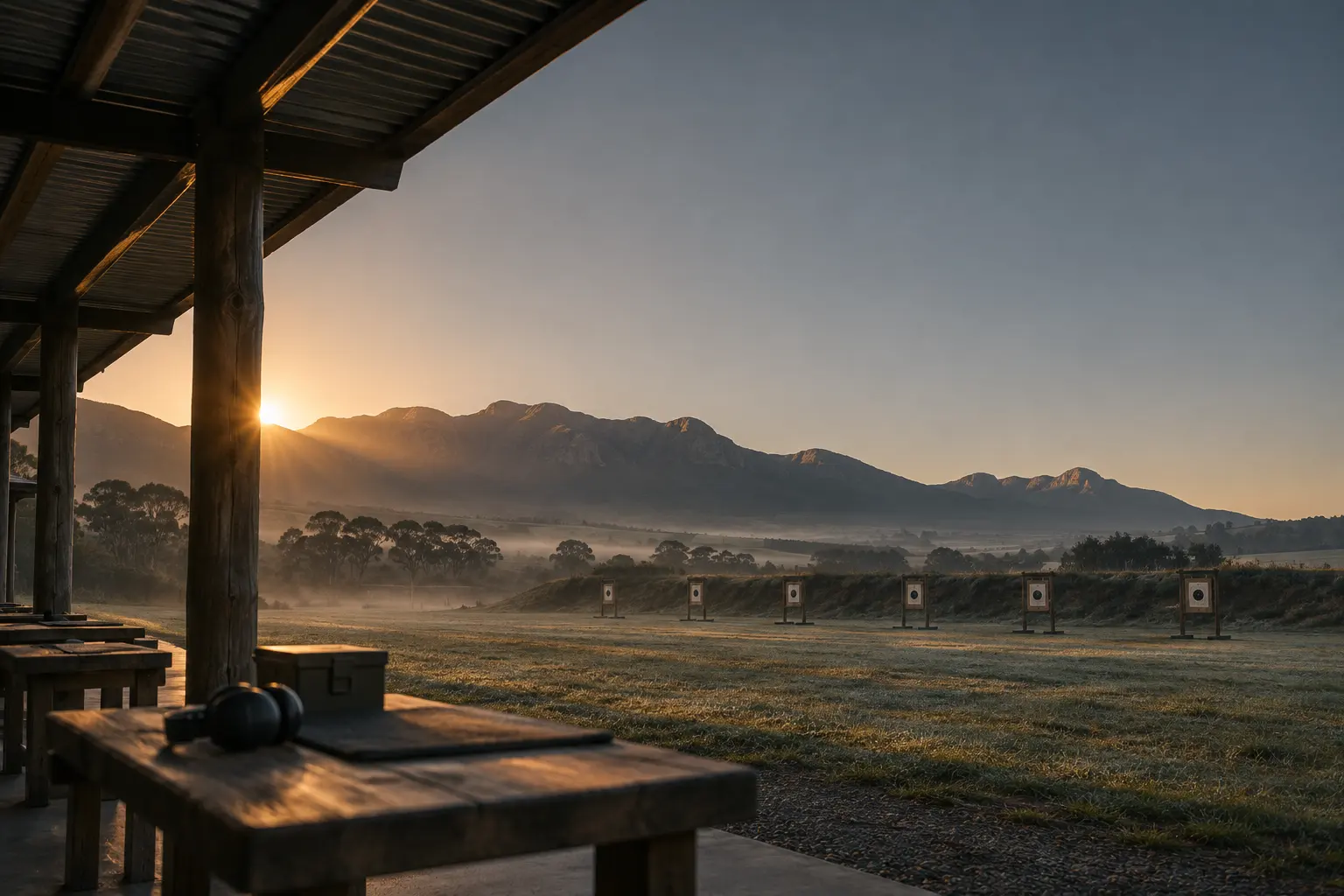
Johan Pretorius has shot clays at his club for years. On his first morning at Ridgeview, Anel hands him an open, empty shotgun and asks him to check it.
Meet Johan Pretorius. He is 58, retired, and has shot clays at his club for most of his life. He knows his way around a shotgun. So why is he here? Because the law asks every owner to show they handle and use a shotgun safely, and because habits drift. On his first morning, Anel Botha, the instructor at Ridgeview, hands him a shotgun with the action open and asks him to check it himself. He does. That is lesson one in a single moment.
Four rules that prevent almost every accident
Four rules. First, treat every shotgun as loaded, every time, even if someone tells you it is empty. Second, keep the muzzle pointed in a safe direction, where a shot could hurt nobody and damage nothing. Third, keep your finger straight along the frame, off the trigger and outside the guard, until your bead is on the target and you have decided to fire. Fourth, know your target and what is behind it, and where the shot will come to rest. These are the first outcome of the unit standard. Break any one of them and the others are all that stand between you and an accident.
Treat every shotgun as loaded
- Check it yourself when you pick it up or take it over
- Open the action and look in the chamber, or both chambers
- Check the magazine tube on a pump or self-loader
- Never trust “it's empty” from anyone, including yourself
Most accidents happen with a firearm someone believed was unloaded. So the habit is simple: whenever you pick up a shotgun or someone hands you one, open the action and check. On a break-action, look into both chambers. On a pump or a self-loader, check the chamber and the magazine tube. Do it even if you put it away empty yourself an hour ago. Anel does it every time, in front of the class, so nobody ever thinks it is beneath them.
A safe direction depends on where you are
| Where | A safe direction | Never |
|---|---|---|
| On the clay stand | Downrange, towards the trap house area, gun pointed up and out | Along the line of shooters |
| Walking between stands | Gun open and empty, over the shoulder or forearm, muzzle up or down | Closed and swinging across people |
| At home | A direction where a shot couldn't go through to a person | Towards rooms where people may be |
| Getting into a vehicle | Unloaded and cased first | Loaded, uncased, on the seat |
A safe direction is not one fixed place. It is wherever a shot could hurt nobody and damage nothing, and it changes as you move. On the stand it is downrange. Between stands, the gun is open and empty, so the muzzle direction matters less, but you still keep it off people. At home, think about walls: shot can pass through a thin wall. And before a shotgun goes near a vehicle, it is unloaded and cased.
Finger off the trigger until you've decided to fire
- Finger straight along the frame
- Outside the trigger guard
- While mounting, walking or waiting
- Finger to the trigger
- Only once the bead is on the target
- And you've decided to shoot
Your trigger finger has two positions. Most of the time it lies straight along the side of the frame, outside the trigger guard. It goes to the trigger only when the shotgun is mounted, the bead is on the target and you have decided to shoot. The moment you stop, it comes straight back out. A stumble, a fright or a cold hand can make a finger tighten. If it isn't on the trigger, nothing happens.
Shot keeps going after it misses
- Shot spreads and slows, but can still injure at a distance
- A slug travels much further, like a rifle bullet
- Know what is behind the target before you fire
Shot spreads into a cloud of pellets and loses speed quickly, but small shot can still carry a few hundred metres and injure someone. A slug is one heavy projectile and goes much further, the way a rifle bullet does. So before you fire, you know what is beyond the target and where the shot will come to rest. On a clay range that thinking has been done for you by the range layout. In the field, it is your job.
What Johan does before every shot
- 1Pick upOpen the action and check
- 2Walk to the standGun open, empty, muzzle safe
- 3On the standLoad only now, when it's his turn
- 4ShootFinger to trigger only on the target
- 5FinishedOpen, unload, show it empty
Here is Johan's routine on the Ridgeview range, and it is the same routine you will use. He picks the shotgun up and opens the action to check it. He walks to the stand with it open and empty. He loads only when he is on the stand and it is his turn. His finger goes to the trigger only when the bead is on the target. When he is done, he opens it, unloads and shows it empty before he steps off.
Your turn
Before lesson 2
- Do the exercise: Safe or unsafe?
- Answer four quick questions on this lesson
- Name the safest direction to point at home
Before you move on, do the exercise, Safe or unsafe?, and answer four quick questions on this lesson. Then, in your own time: name the safest direction to point a shotgun in your home, and why. Next: the parts of a shotgun and how each type works.
Do: Safe or unsafe?
Johan and the other delegates are on the Ridgeview range. Decide whether each action is safe or unsafe.
Check
Four quick questions. The reason shows as soon as you answer.
Apply
Where this shows up in your own life.
Name the safest direction to point a shotgun in your home, and why
Ridgeview Firearms Academy and its people are fictional. This is study material written from the Firearms Control Act and the SAQA unit standards. It isn't an accredited course or legal advice; your accredited training provider runs the official tests.