Courses / The Firearms Control Act / Lesson 6
Carrying, transport and storage
Covered in public, locked away at home. Lesson 6 of 8 · about 9 minutes to watch.
Watch
Step through the slides. The trainer's words are under each one.
Carrying, transport and storage
Firearms Act, lesson 6 of 8: covered in public, locked away at home
Today: where your firearm may be, and how. On you and covered, or locked in a safe.
On you, or in the safe
- On your body or under your direct control
- Covered, in a holster or holder
- Never left unattended
- Everywhere else
- In a SABS 953 safe or strongroom
- With its ammunition
Here's the simplest way to remember it. A firearm is either on you and under your direct control, or it's locked in a safe. Regulation 86(1): when it isn't under your direct personal and physical control, the firearm and its ammunition must be in a safe or strongroom meeting SABS 953-1 or 953-2. There is no third option.
Carrying in public: section 84
- Handgun: in a holster or holder on your body
- Or in a rucksack or similar bag
- Completely covered
- Rifle or shotgun: in a holder made for it
- Completely covered
- Under your effective control
Section 84. Sipho's pistol, in public, must be in a holster or similar holder on his body, or in a rucksack or similar bag. Marike's rifle and Johan's shotgun must be in a holder made for them. Either way: completely covered, and under effective control. Open carry in public isn't allowed. And if a police official asks, section 107 says you must produce your licence and identify yourself.
Moving a firearm
- 1UnloadCheck the chamber and magazine
- 2Case itCovered, in its holder
- 3Keep controlWith you, or in a bolted lock-away safe
- 4Unload at the other endStraight into the safe
Section 83 says firearms must be stored and transported in the prescribed manner. In practice: unloaded, cased and covered, and under your control. If you must leave it in a vehicle, regulation 86(12) describes a lock-away safe: steel at least 2 mm thick, enclosing the whole firearm, with its own lock, bolted to the vehicle. Transporting other people's firearms for pay needs a permit under section 86.
Where firearms aren't allowed
- Declared firearm-free zones (section 140)
- Anywhere a sign or notice says so
- Hand it in for safekeeping where offered
Some places are declared firearm-free zones under section 140, and firearms aren't allowed there at all. Many premises also have firearm control, where a designated person may keep your firearm for you under regulation 86(5).
The safe rules
The detail from regulation 86. A safe meeting SABS 953-1 or a strongroom meeting 953-2, fixed as the standard requires. Only you should have access, or it shouldn't open without you there. Firearms other than a section 13 self-defence firearm must be stored unloaded. Keep the keys or code safe: section 120(8) makes losing a firearm through careless keys an offence. You may only store someone else's firearm with their written permission, endorsed by the DFO, and you may not use it.
Moving house
- Tell the DFO your new address
- The DFO checks your safe at the new address
- Change of circumstances within 30 days
Regulation 100: when you move, notify the DFO, who checks that the safe at the new address complies. Section 26 requires you to notify changes to the information in your application within thirty days.
Sipho's plan
- Safe in the main bedroom cupboard, bolted to the floor
- Keys on him by day, in a lockbox at night
- Pistol on him or in the safe, nowhere else
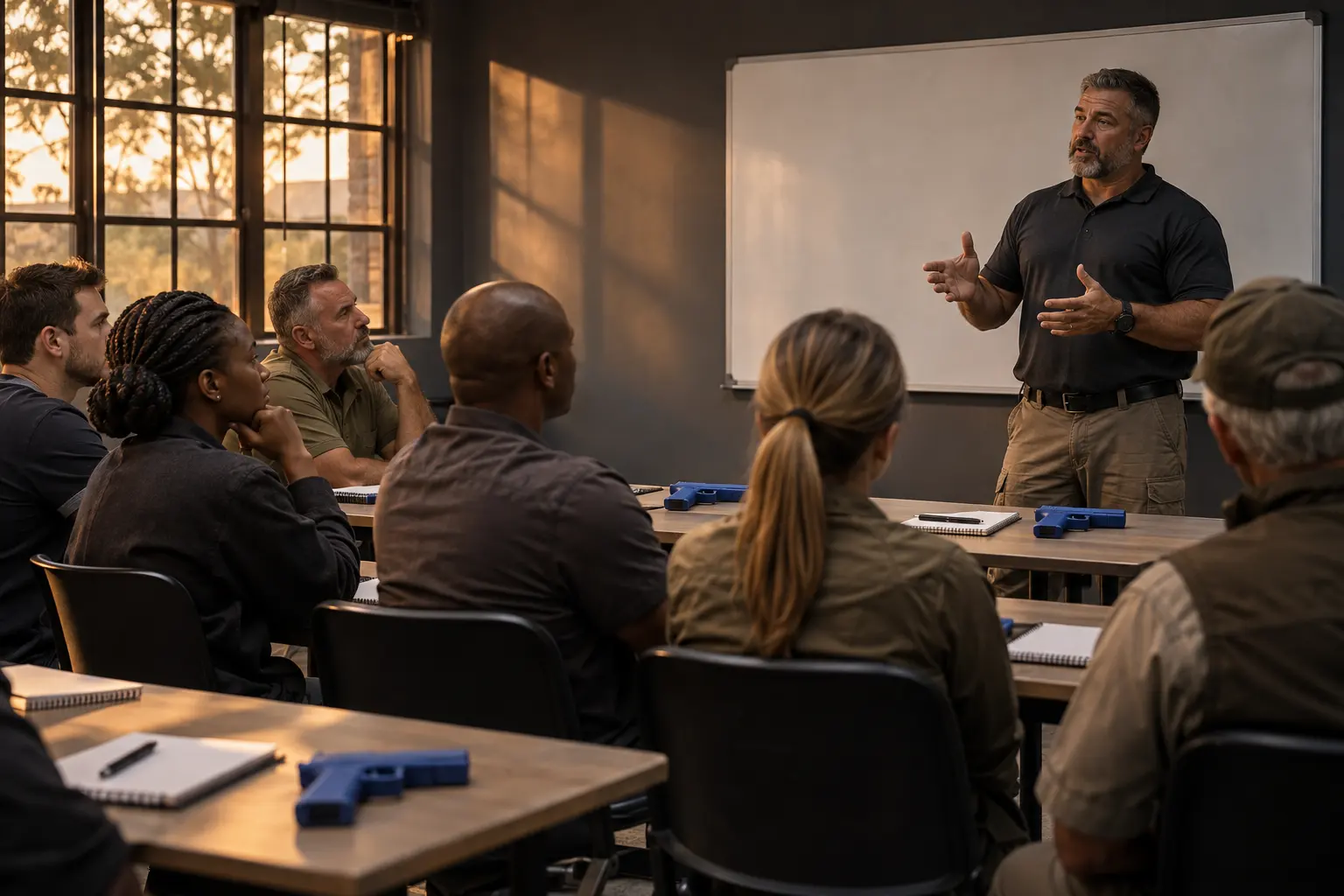
Anel asks each delegate to describe their plan. Sipho's: the safe bolted to the floor of the bedroom cupboard, keys on him by day and in a lockbox at night, and the pistol either on him or in the safe. Anel nods: that's the rule in practice.
Your turn
Before lesson 7
- Do the exercise: Lawful or not?
- Answer four quick questions on this lesson
- Decide where your safe will go and how it will be bolted
Before lesson 7, decide whether ten situations are lawful, and answer four questions. Then decide exactly where your safe will go. Next: loss, disposal and deceased estates.
Do: Lawful or not?
Is each of these lawful under the Act and Regulations?
Check
Four quick questions. The reason shows as soon as you answer.
Apply
Where this shows up in your own life.
Decide exactly where your safe will go and how it will be bolted down.
Ridgeview Firearms Academy and its people are fictional. This is study material written from the Firearms Control Act and the SAQA unit standards. It isn't an accredited course or legal advice; your accredited training provider runs the official tests.